

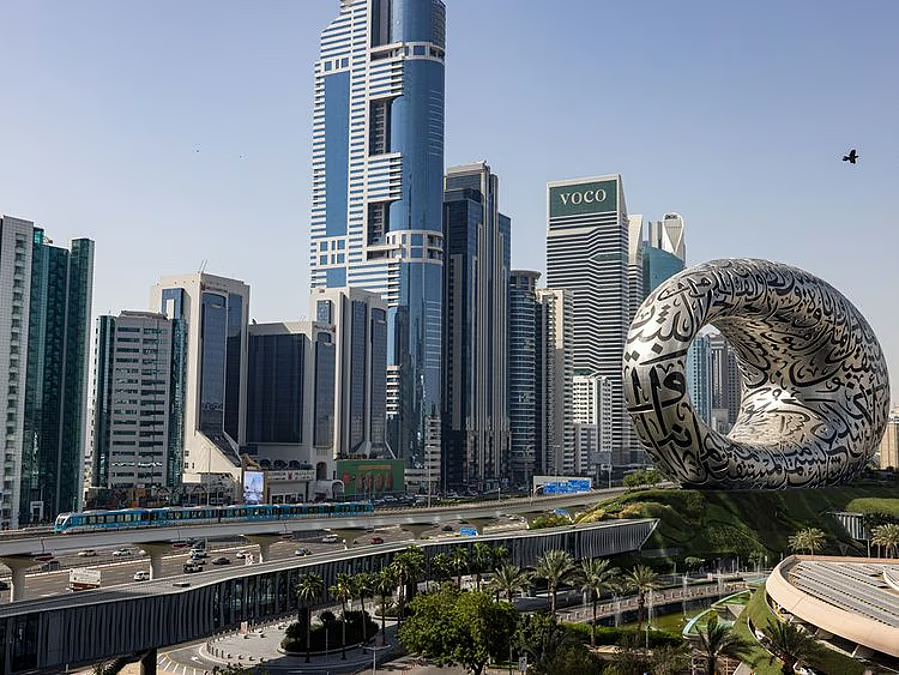
Dubai’s property market is showing some cracks amid the ongoing geopolitical tensions in West Asia, but it is not collapsing. Prices are largely holding steady, developers are relying on incentives rather than cutting prices, and the emirate’s fundamentals remain intact. That said, transaction volumes have taken a noticeable hit in early March 2026, and for those tracking trade, finance and Asia-Gulf linkages, this slowdown is worth watching closely.
Fresh data reported by Reuters on March 20, 2026 highlights the pressure. Real estate transaction volumes in the UAE fell 37% year on year in the first 12 days of March and 49% month on month, according to Goldman Sachs estimates. Transaction values were also down sharply compared to February, while median prices eased by around 3% year on year. The pattern suggests a market where activity has slowed faster than pricing, pointing to caution rather than distress.
Developers are responding by offering fee waivers, extended payment plans and other incentives to sustain demand without resetting price benchmarks. There has been no broad-based price correction so far, indicating an effort to protect valuations. At the same time, selective discounting is beginning to appear in parts of the market, with some secondary properties, including units near Burj Khalifa and Palm Jumeirah, being marketed at discounts in the range of 10–15%, suggesting early signs of pricing pressure at the margins.
The implications extend beyond real estate. Dubai’s property market has historically acted as a barometer for broader economic activity. A slowdown in transactions can signal softer momentum in linked sectors such as construction, logistics, warehousing and re-exports through Jebel Ali and associated free zones. A prolonged moderation could also affect employment across the expatriate workforce that supports construction, real estate services and related sectors, with potential spillover effects into retail, hospitality and consumption.
Dubai property: What It Means
There are also implications for capital flows. Dubai’s growth model is closely tied to global liquidity and investor confidence. A more cautious investment environment could translate into tighter lending conditions, more selective capital deployment and a gradual shift of marginal investments toward alternative hubs. Some global banks have already flagged rising risks, with Citi pointing to downside scenarios for Dubai’s property market if regional uncertainty persists, including the possibility of a multi-year moderation in prices and demand.
The Asia linkage remains particularly important. Dubai serves as a key node connecting capital, trade and business flows between the Gulf and markets such as India, Singapore, Hong Kong, Malaysia and Vietnam. Any sustained slowdown could influence cross-border investment decisions, even if such shifts are gradual.
Remittances present another potential risk channel. The UAE remains a major source of remittance flows to South Asia. If real estate and construction activity weakens over an extended period, it could eventually affect employment and income levels, with downstream effects on consumption in key recipient markets.
S&P Global Ratings noted in its mid-March 2026 assessment that a systemic correction on the scale of 2008 remains unlikely due to stronger regulatory frameworks and financial buffers. However, it also described the current environment as a stress test, warning that a prolonged conflict could lead to further declines in transaction volumes and prices, particularly in segments with higher supply such as apartments.
For now, the market remains relatively resilient, with some segments continuing to see activity. However, the early March slowdown serves as a clear signal. Dubai’s property market is closely linked to trade flows, workforce dynamics and capital movement across the Gulf-Asia corridor. The coming weeks will be critical in determining whether this is a short-term disruption or the beginning of a more sustained adjustment.
Related on Digital Trade Outlook
- Export Finance Recalibrates as Geopolitical Risks Disrupt Trade Flows
- West Asia Tensions Put China’s Energy Security and Trade Flows in Focus
- Dubai Gold Market Sees Diaspora Selling as Geopolitical Tensions Raise Cash Demand